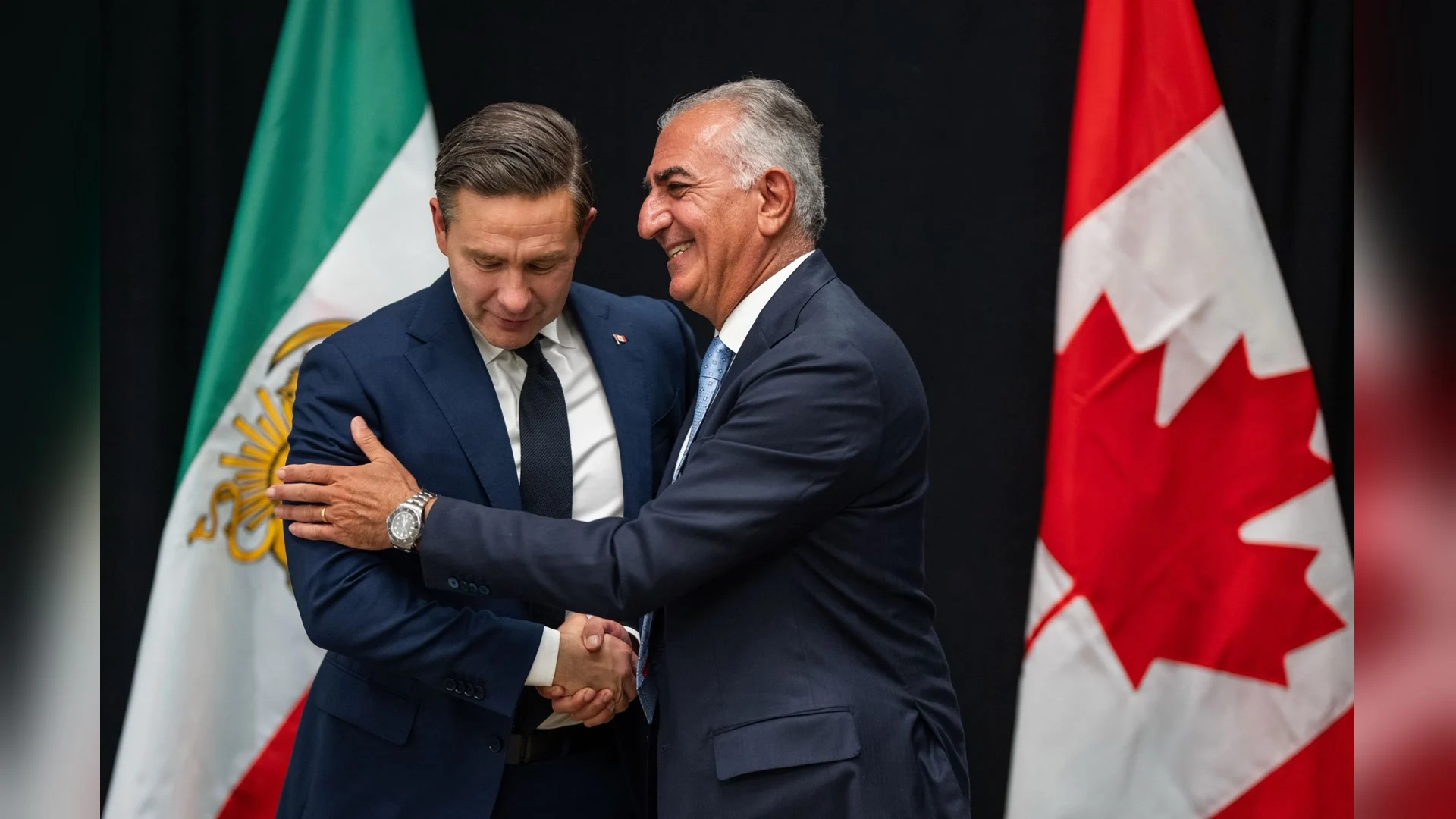
The recent invitation to Prince Reza Pahlavi from Australia's Coalition (the opposition), and the meeting of Canada's opposition leader with him in Toronto, signal the emergence of a strategic line of thinking in Western countries on the question of Iran. These meetings carry several political meanings: recognizing the voice of the Iranian diaspora, reflecting the plight of the Iranian people, identifying the opportunities a free Iran can offer the West, and confronting the Islamic Republic's threats against the national security of Western countries, even distant countries such as Australia and Canada.
Relations between countries such as Canada and Australia and the Islamic Republic have suffered a fundamental rupture in recent years. Both countries have designated the Islamic Revolutionary Guard Corps (IRGC) as a state entity that sponsors terrorism, expelled the regime's ambassadors and suspended the operations of their embassies in Tehran. In this context, continuing to deal with the regime as the only legitimate interlocutor for these countries is, on the whole, at odds with this diplomatic rupture.
Moreover, the strategic reasons for rethinking the approach to Iran go beyond short-term considerations. The regime's threat to the security of the Strait of Hormuz has exposed the energy vulnerability of prosperous Western countries: any disruption in the strait or in the Persian Gulf region affects fuel supply, fertilizer imports, trade routes and key transit points.
The Islamic Republic's proxy networks also pose risks to the domestic security of Western countries, including recruitment for espionage and terrorist acts. The activities of IRGC proxy forces against Jewish targets in Europe, North America and Australia have recently drawn the particular attention of Western security agencies.
In addition, the Islamic regime's alignment with authoritarian countries such as Russia and China creates compounded risks for Australia, Canada, New Zealand and other US allies in the event of a large-scale international conflict. While the survival of this regime leads only to continued threats against the national security and interests of Western countries, its fall will create many opportunities for them. The efforts of Iranians, and Prince Reza Pahlavi's persistence in conveying the voice of Iranians, have drawn the attention of important parts of Western politics to the question of Iran.
Now the fall of this regime is no longer a distant dream, because it is under intense pressure from three fronts: Israel, the United States and the people of Iran. The synergy of these forces leads to a single outcome: the collapse of the Islamic system that emerged from the 1979 revolution. The person who can lead this mission to its conclusion is Prince Reza Pahlavi.
Beyond the chants of the millions of Iranians who called for his return during the uprising of Dey (December–January), Prince Reza Pahlavi has also organized the largest recent gatherings of Iranians living abroad. In Australia and Canada, on 14 February, hundreds of thousands of Iranians answered his call for global action and demonstrated in the main cities of these countries.
Responding to the demands of this community and engaging with those working for a free and democratic Iran are in line both with the values of the Western world and with the national interests of these countries.
A free Iran can become an economic and strategic partner for Western countries.
Prince Reza Pahlavi's stated goal is the establishment of a secular democracy in which Iran's territorial integrity and the fundamental rights of individuals are guaranteed, and in which the people themselves determine the final form of the country's government through a referendum. Few leaders have expressed such an explicit commitment and, at the same time, presented a detailed, written plan for the transition period.
This plan, called the Iran Prosperity Project, covers matters such as running affairs in emergency conditions, maintaining security, economic stability, holding a referendum to determine the form of government, and going through the process of drafting a constitution. The aim of this plan is to prevent a power vacuum and state collapse of the kind that happened before, for example in Iraq and Libya, and to guide Iran onto a path of prosperity and democracy.
An Iran after the end of religious rule, following the foreign policy that Prince Reza Pahlavi envisions, will directly reduce the existing threats against the countries of the region and other nations of the world. Ending state support for terrorism, proxy networks and antisemitic operations, halting the nuclear weapons program and recognizing Israel will reduce the activities that have played a part in incidents on European, Australian and North American soil and in instability across the Middle East.
A free Iran will also pave the way for broad economic cooperation. With a population of close to 90 million, Iran is one of the largest markets still closed to Western economies. Iran also has many rare features: a large and young population, a high annual output of graduates in science, technology, engineering and mathematics, a diverse industrial base, a strategic location linking Central Asia, the Persian Gulf and South Asia, and abundant energy, mineral and agricultural resources.
For example, one can point to a complementary mining partnership between Australia and a free Iran: a partnership that combines Australia's capital, technology and operational expertise with Iran's extensive mineral deposits. Nearly five decades of isolation and limited access to international technology and capital have left much of Iran's vast resource reserves still undeveloped. Australia can provide capital and technology, and Iran can offer resources, lower-cost processing and a geographic position close to Europe, India and the Middle East.
A free Iran can become an economic and strategic partner for Western countries. Months of US efforts to find a credible interlocutor inside the regime have shown the world that the solution can only be sought outside the framework of this Islamic regime; and beyond the regime there is only one alternative, and that is Pahlavi. The important question facing Western politicians, therefore, is this: can they forgo engagement with the Iranian figure who has the greatest acceptance, organizational capacity and willingness to support a democratic transition?
To non-Iranian audiences, Prince Reza Pahlavi is often known through his heritage: the son of the Shah, the Crown Prince of Iran and heir to the Iranian monarchy. In recent years, however, he has increasingly defined his role on his own personal and independent terms. He has always described himself as a national figure and the leader of Iran's revolution and democratic transition.
Engaging with Pahlavi does not mean foreign countries endorsing the restoration of the monarchy, because Prince Reza Pahlavi enjoys the very endorsement he needs: the support of the Iranian people.
Prince Reza Pahlavi is the best-known opponent of the regime and a leader with broad support among Iranians. He also has a detailed plan for the transition period. Meanwhile, the Islamic Republic is under more pressure than ever before and on the verge of suffocation. All Western countries, such as Canada and Australia, have already deemed this regime a threat to their security and values. Therefore, engaging with a figure whom many Iranians consider the only available alternative is not only consistent with these countries' policies but is the logical next step in preparing for the era after the Islamic Republic.
Originally published in The Australian(opens in a new tab), 17 September 2026.